

Ice Maker Not Working? Safe Checks Before Repair
An ice maker that stops producing ice may have a water supply, temperature, sensor or electrical issue. Use these safe checks before booking residential electric refrigerator repair.
- Licensed & insured
- Workmanship warranty
- Same-day / next-day service
- Locally owned & operated
Limited-time promotion for new residential customers. Mention the offer when booking. Cannot be combined with other discounts.
Ice Maker Not Working? Safe Checks Before Repair
An ice maker can stop producing ice even while the refrigerator and freezer seem to be operating. Ice production needs adequate freezer temperature, a working water supply and correctly functioning appliance controls. The symptom can range from an empty bin to small cubes, a frozen clump or water that never reaches the tray. Safe observations help determine the next step without risking damage to the appliance or a water leak.
Check the simple, accessible conditions
First, confirm that the ice maker has not been switched off by its normal user control. Consult the appliance instructions for the control location rather than forcing an arm, tray or lever. Make sure the freezer door closes fully and that packages are not blocking the ice maker area or preventing cold air from circulating.
If the refrigerator has a dispenser, see whether water dispenses normally without running repeated tests. A change in water flow, a recently replaced filter, or a new noise during a water request are useful facts to record. Do not disconnect, tighten or replace hidden water lines as a troubleshooting experiment. Water and electrical equipment are close together around a refrigerator, so a leak or wet floor should be handled cautiously.
Check whether the freezer itself is maintaining normal cold conditions. An ice maker may stop before other food seems noticeably affected, but a warm freezer or softened frozen food is a more urgent food-storage issue. Avoid opening the door repeatedly to check for new cubes. That lets warm air in and can delay normal operation.
Describe what the ice maker is doing
Write down whether the bin is completely empty, production has slowed, cubes are unusually small, or ice is clumping together. Also note whether the issue began after a power outage, filter change, move, water interruption or long period with the door open. A display code, clicking sound, visible frost or water collecting near the ice maker should be mentioned when booking.
Do not use hair dryers, sharp tools or hot water inside the appliance to clear ice. Do not remove panels, override switches or force the ejector mechanism. These methods can damage plastic parts, wiring or hidden water paths and may create a larger repair.
What a residential electric refrigerator diagnosis can cover
We assess accessible ice-maker, dispenser, water-related, temperature-control and electrical conditions according to the reported symptom. The purpose is to identify a practical repair path, not to assume that every empty bin needs the same part. Have the model number ready and say whether the refrigerator is built in, recently installed, connected to a filter or water line, or showing any cooling changes.
Sealed-system, compressor and refrigerant work is outside our scope. Do not attempt refrigerant products or pierce cooling tubing in response to an ice maker problem.
Before service, empty loose ice from the bin if it can be done normally and clear safe access around the refrigerator. The $89 diagnostic is waived with repair; most repairs are $150-$350, and new customers receive $40 off any repair. Book service if normal controls and door closure are confirmed but the ice maker remains inactive, leaks, or shows repeated unusual behaviour.
Serving York Region & the Greater Toronto Area
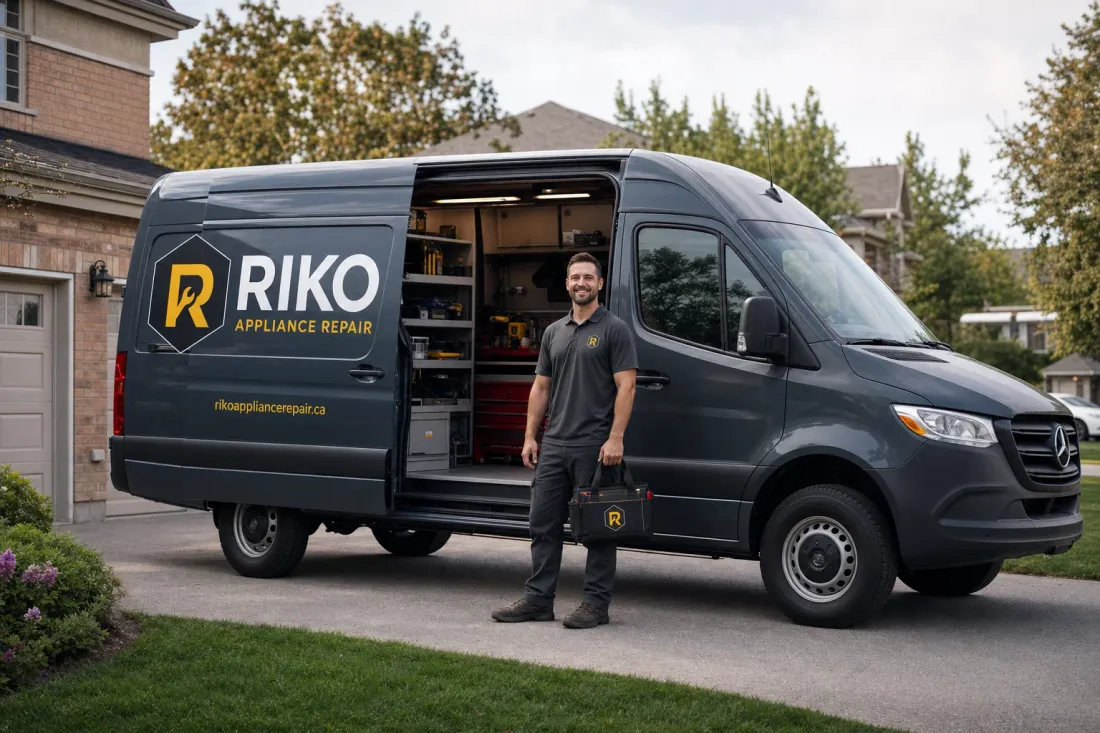
Locally owned & operated
No call centres and no out-of-town subcontractors — our own certified technicians and service vans cover the whole area. Drive times stay short, so you usually get same-day or next-day service from someone who already knows your neighbourhood.
Ice Maker Not Working? Safe Checks Before Repair — quick answers
Why did my ice maker stop making ice?
Ice production depends on freezer temperature, water supply and several appliance functions, so a clear symptom description is more useful than guessing at one part.
Should I force the ice maker arm or tray?
No. Do not force moving parts, use sharp tools, or disassemble the ice maker while the refrigerator is connected.
Does an ice maker issue mean refrigerant work is needed?
Not necessarily. Sealed-system, compressor and refrigerant work is outside our scope; accessible electrical and water-related conditions can be diagnosed separately.
What does refrigerator repair cost?
The $89 diagnostic is waived with repair; most repairs are $150-$350, and new customers receive $40 off any repair.
Let's get your appliance working again
$40 Off + $89 Diagnostic Waivedcare@rikoappliancerepair.ca · Mon–Sat 8–8, Sun 9–6