

Electric Oven Not Heating: Safe Checks & Repair
When an electric oven refuses to make heat, the failure usually sits somewhere in the high-voltage cooking circuit — a bake or broil element, the oven thermostat, a control relay, or the temperature sensor feeding the board. Whether it stays stone cold, warms weakly, or heats then quits mid-bake tells a technician where to look first.
- Licensed & insured
- Workmanship warranty
- Same-day / next-day service
- Locally owned & operated
Limited-time promotion for new residential customers. Mention the offer when booking. Cannot be combined with other discounts.
Electric Oven Not Heating: Safe Checks & Repair
No heat, weak heat, or heat that quits are three different faults
The first thing worth noticing is exactly how the oven misbehaves. An oven that produces no warmth whatsoever points toward an open circuit — a broken element, a failed relay, or a sensor circuit the control reads as faulty and then refuses to power. Weak heat that never climbs to the selected temperature can involve one element working while a second stays dead, or a control cutting power early. Heat that builds normally and then drops out partway through a bake often traces to the high-limit safety or the oven thermostat opening when the feedback it senses is off. Noting which of these three patterns you see saves guesswork later.
Which mode fails narrows the search
Most electric ovens carry two separate heating elements: a bake element along the floor of the cavity and a broil element across the top. If baking works but the broiler stays cold — or the reverse — the fault is likely isolated to the element or wiring for that one mode rather than the shared control. When both modes are dead, attention shifts toward the parts they have in common: the relay board that switches them, the temperature sensor, or the incoming supply. A simple observation like “bake fine, broil dead” is genuinely useful before anyone opens the appliance.
A working display does not prove the oven can heat
It is easy to assume a bright, responsive control panel means the oven is healthy. It does not. The display and touch pad run on a low-voltage circuit that is entirely separate from the 240-volt supply feeding the elements. A lit clock only confirms the logic side has power; the heating side can be fully open while the panel looks perfectly normal. That is why “the screen works, so it can’t be electrical” is a misleading conclusion, and why the elements, relay, sensor and thermostat each have to be checked on their own.
A blistered element, a burning odour, or a tripped breaker means stop
Some faults are visible. A bake or broil element showing a blistered, split, or bright-scorched section has usually failed and can arc. If switching the oven on trips the breaker, or you catch a hot, acrid odour or any smoke, turn it off at the panel and leave it off — those signs point to a shorted element or damaged wiring, and repeatedly resetting the breaker only risks more damage. Please do not pull the range out to probe live terminals; confirming the fault means testing energized 240-volt parts and is not a safe do-it-yourself job.
Booking a visit and what to expect on cost
Riko is licensed and insured, backs its work with a workmanship warranty, and covers Toronto along with communities across the GTA — from Scarborough and North York out to Markham, Vaughan and the surrounding neighbourhoods. A technician confirms whether the trouble is a specific element, the sensor, the relay, or the thermostat before recommending anything, so you are not paying to swap a part a forum guessed at. The visit to pin down the fault is $89, and that charge comes off your bill the moment you approve the fix. Once the part and labour are identified, a completed oven repair generally runs somewhere in the $150 to $350 range, and a household calling us for the first time can take $40 off that repair total. One boundary worth stating plainly: this work covers residential electric ovens. Gas ranges and gas lines, restaurant and other commercial equipment, and sealed refrigeration or compressor systems all fall outside what we handle — and apart from dishwasher setup, we repair appliances rather than install them.
Serving York Region & the Greater Toronto Area
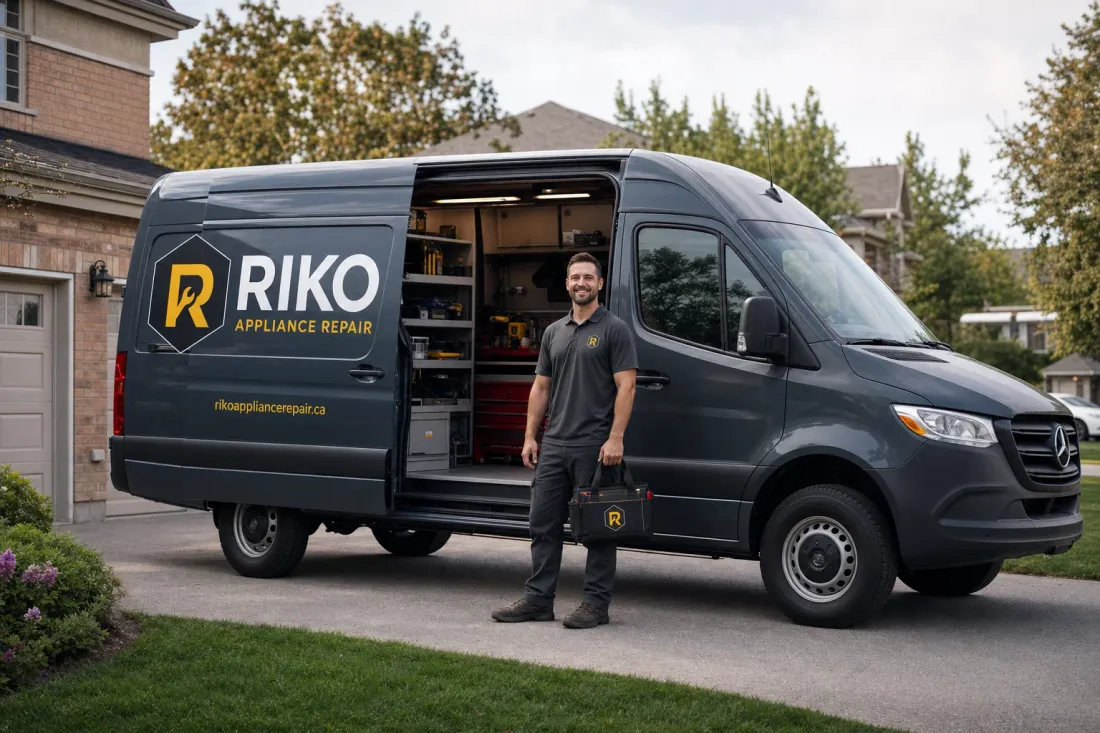
Locally owned & operated
No call centres and no out-of-town subcontractors — our own certified technicians and service vans cover the whole area. Drive times stay short, so you usually get same-day or next-day service from someone who already knows your neighbourhood.
Electric Oven Not Heating: Safe Checks & Repair — quick answers
My display lights up but the oven never gets hot — why?
The panel and the heating side run on separate circuits, so a lit display only proves the low-voltage electronics have power. A dead element, an open sensor circuit, or a control relay that will not switch can each leave the cavity cold, and each needs diagnosis.
The oven heats up and then shuts off before the food is done — same issue?
Not necessarily. Heat that builds and then quits can point to the oven thermostat or a high-limit safety opening, or a temperature sensor reading incorrectly, rather than a burnt-out element. It is a different pattern and may involve different parts.
There was a burning odour and the breaker tripped — is it safe to keep trying?
No. A hot odour, smoke, or a breaker that trips can indicate a shorted element or damaged wiring. Switch the oven off at the panel, leave it off, and book a visit rather than resetting it repeatedly.
Baking works but the broiler stays cold — does that tell you anything?
Yes. Bake and broil use separate elements, so trouble confined to one mode often isolates the problem to that element or its wiring. Which mode fails is worth mentioning when you book, though it still needs on-site testing to confirm.
Let's get your appliance working again
$40 Off + $89 Diagnostic Waivedcare@rikoappliancerepair.ca · Mon–Sat 8–8, Sun 9–6